

Reflections on the mirror in Grimm’s SNOW WHITE

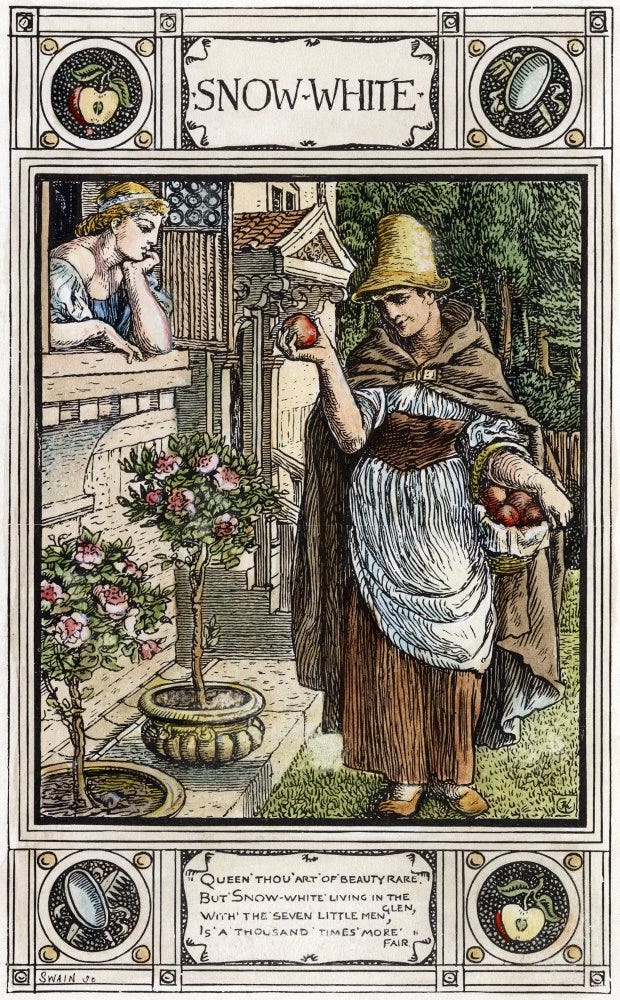
In an introduction to the Snow White tale type in his collection, Golden Age of Folk and Fairy Tales, fairy tale translator and critic Jack Zipes relates that oral variations were collected in Western Asia, North Africa, and Europe during the nineteenth century that reveal the popularity of this tale type. He includes many stories from other countries in his collection. But it is the Grimm’s’ version of the tale that eclipsed all others in popularity. Only in the Grimm’s’ version of this tale type does a magic mirror have such a central and repeating motif, one that has terrified, delighted, and enchanted audiences and readers to this day.
Jacob Grimm’s brother Ferdinand apparently gave him the first version of the tale in 1806, which Jacob then included in a hand-written letter to his mentor Carl von Savigny. This letter was translated by Jack Zipes and included in the aforementioned book. The mirror is present in this tale, but only speaks out loud at the beginning, when Snow White’s mother asks:
“Mirror, mirror, on the wall, who is the most beautiful woman in England?”
The reply of the mirror is:
“Snow White is a hundred thousand times more beautiful”
Besides the hyperbole of a “hundred thousand times,” which is so absurd it is almost laughable, the narrative surprisingly sets the tale in England. One major attribute that differentiates the fairy tale from realistic fiction is the lack of a specific place for its setting, and in the first written version in the 1812 Grimm’s’ collection, the specific place of England is no longer mentioned by the mirror in the story. To name a place in a story, the reader might jump to the conclusion that perhaps there was indeed a very real, historic, murderous queen involved. It is easy to imagine why this was edited out.
What has made fairy tales so appealing for so many generations is just that very lack of specificity–the reader can enter a land of “once upon a time, in a faraway kingdom,” an almost dream-like place where the often harsh, violent, events exist, not in a real place, but in an almost mythical realm where magic, animal helpers, and fairy godmothers are accepted realities, and the protagonists in the story always win against impossible odds.
The rest of this early hand-written tale contains the dwarfs, the three temptations, and the glass casket motif of the familiar Grimm’s’ tale. However, the queen herself drives into the forest, tells Snow White to get out and pick her a beautiful rose, and then abandons her to the wild beasts. The queen’s anger develops slowly. The storyteller does not use the device of the mirror directly again, but the queen simply “learned” that her daughter was alive again after each episode. This lack of a repeating motif with the powerful image of a magic mirror speaking makes this early tale lacking in the more dramatic impact of the first printed version by the Grimm brothers in 1812.
The beginning of the first print version of Snow White is the same as the hand-penned version—a queen looking out her window, pricks her finger and declares her desire for a daughter “as white as snow, as red as blood, and as black as the wood of the window frame.” But Wilhelm Grimm had gathered more versions of the tale, according to Zipes, and perhaps that is why the magic mirror gained greater prominence in the first print version. Another significant change occurred in a revised edition for children, where the tales were made a less shocking, especially any reference to sexual content. In the story of Snow White, the brothers chose to soften the impact of maternal filicide by changing the evil mother into an evil stepmother. In the 1812 version, the mirror’s answer to Snow White’s (biological) mother is “You my queen have a beauty quite rare, but snow white is a thousand times more fair.” These are the identical words spoken, but to the stepmother, in the later versions. However, in the context of having a desire for a beautiful daughter and then trying to murder that daughter because she is more beautiful, the first version of the story produces a much more horrifying image in the reader/listener. An evil stepmother, a wicked witch, can more easily be understood as having her own self interests at heart, however demented they are.
The Grimm’s brothers use the fairytale trope of things happening threes in having the mirror repeat the same message each time after the queen thinks she has killed Snow White. When she asks the mirror who is fairest in the land, the mirror speaks its reply:
“You my queen, have a beauty quite rare
But beyond seven mountains, this I must tell
Snow White is living and doing quite well.
And yes, she’s still a thousand times more fair.”
The hyperbole of Snow White being ten thousand times more fair has been reduced and edited down to a mere thousand times more fair, still an obvious exaggeration but not an absurd one, and this simple change by the Grimm brothers strengthens its impact. This message of a beautiful young girl surpassing an aging beauty has led many people studying this tale to ask, “Whose is the voice of the mirror?”
For Jack Zipes , the tale is not primarily about the dangers of pride and envy, but rather the voice of the mirror sounds to him like the voice of a male-dominated society where the highest appreciation of a woman is prescribed as the quest to become as beautiful and thereby as attractive to men as possible. He raises an interesting point, and it is noteworthy that her beauty is the main factor in the huntsmen’s pity, the dwarfs taking her in, and the prince’s fascination for a seemingly dead (but beautiful!) body.
After each attempt to end Snow White’s life by offering her trinkets that appeal to her —and mirror the queen’s own vanity—laces to accent her breasts, a beautiful comb to accentuate her hair, a red-ripe apple to symbolize sexual knowledge, the queen becomes more and more enraged after hearing the words of the mirror repeated again and again. The unhappy queen/stepmother is obsessed with doing away with whatever stands in her way to retain her youthful beauty and the title of the fairest in the land.
Thoughts: Beauty is transcendent. Timeless beauty transports us. It is natural to want to turn something of beauty into art—artists have always been inspired by a beautiful landscape, a beautiful object, a beautiful face. Seeing beauty gives us pleasure. We are hardwired for beauty. The law of attraction sends men messages when they see an attractive member of the opposite sex. It is biology. And yes, we are civilized creatures, but this stuff is lizard-brain hard wired. The desire of the stepmother to remain beautiful, attractive, to be framed as an icon of perfection, a god(dess) as it were, is a deep-seated human desire that walks hand-in-hand with the fear of death. Beauty feels deathless. However, looking into a mirror one sees not just the present image, but a future version of what that face might look like. And remembers a past version of one’s younger and more vibrant self. And one usually sees only the flaws and imperfections that others never notice. It can be argued that the queen’s anger at not being the most fair was simply hiding her fear, as anger at its root is often simply masking fear. The mirror magnified that fear, personifying it into the body of Snow White, but arguably the queen would have hated anyone, and would inevitably have had other younger women surpassing her in beauty. The queen was jealous, yes. Narcissistic, yes. A sociopathic homicidal maniac, yes. But at the core of her being, she simply had not accepted her mortality. To her, beauty was commensurate with immortality, and if she could hold on to that title of most fair, most beautiful, she could somehow beat death.
To be beautiful feels like the farthest thing from death, for beauty is a transcendental ideal, something to be framed as art, everlasting. The final proclamation the mirror makes in the Grimm’s tale is,
“My queen, you may be fairest here,
But the young queen is a thousand times more fair.”
The queen’s anger is now gone, and the text states that she was “paralyzed with fear” She hears the words that the young queen (her replacement) is a thousand times more fair. More alive. The queen cannot move–she has lost. Life is the victor, the eternal rebirth of new beauty, and the aging beauty must die for trying to steal the very life of Snow White in a mad and fruitless attempt to escape the inevitable cycle of life, and her own death. This is the metaphor of the mirror for me, perhaps because I am well past the queen’s age and looking into that mirror is reflecting my own mortality. The metaphor of the mirror strikes us all.
hello from another mythology/folklore-related Substacker!